October 7, 2026
Winery holiday marketing plan: a countdown from October through January
Holiday sales don’t start in December. The decisions that shape them—what you’ll offer, when you’ll stop shipping, whether your checkout works on a phone—get made weeks earlier, and for plenty of wineries they get made in a hurry in mid-November, when gift shoppers are already looking.
That timing is especially rough if you’re in the middle of harvest, or just coming out of it. You’re tired, the crew is stretched thin, and holiday marketing is probably the last thing you want to think about. But this isn’t the time to take your foot off the gas, even if you’d love to. It doesn’t take a sprint, either. A few small jobs done now will make the end of the year far easier.
The market gives you another reason to be deliberate. Silicon Valley Bank’s wine division (known as SVB, and now part of First Citizens Bank) published its 2026 direct-to-consumer wine report this year, based on responses from 450 wineries. It found that the downturn in direct-to-consumer (DTC) sales, meaning wine you sell straight to customers through your tasting room, wine club, and website, appears to be past its worst, though growth hasn’t returned. Top-quartile wineries grew their DTC revenue by 22%, the median winery was flat, and the bottom quartile fell 13%. The report ties that gap to how wineries build and maintain relationships with their customers, and the holidays are one of your best chances to do exactly that.
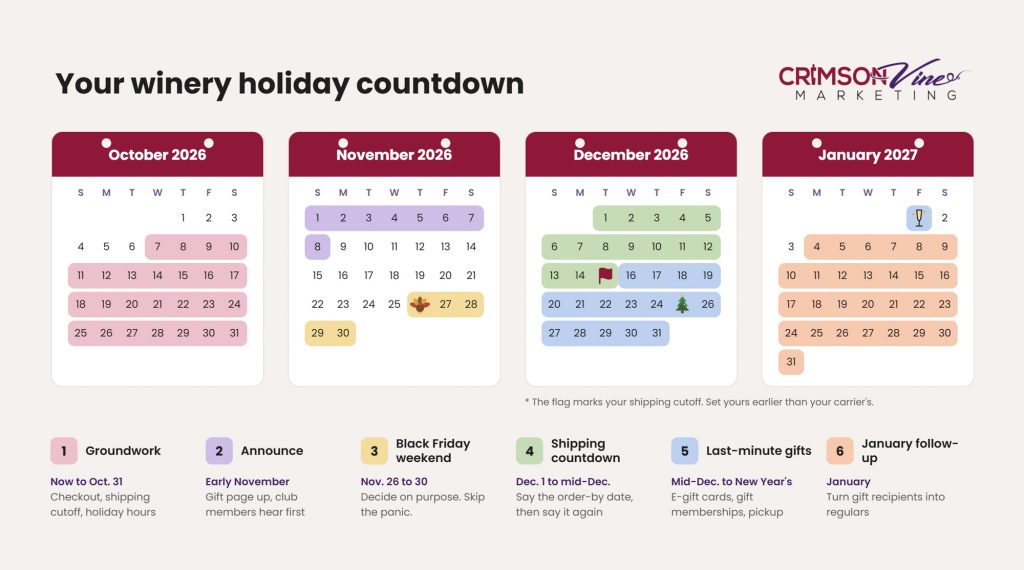
Let’s be real: No holiday plan can change the market. But what it can do is make sure the people who already like your wine can find a gift option, order it, and get it there on time. What follows is a plan built around the 2026 calendar, from the groundwork you can do now to the follow-up in January.
Key takeaways
- Holiday sales are shaped by decisions made weeks before the first gift order, including your offers, shipping cutoff, and checkout
- Pick one main goal for the season instead of trying to promote everything at once
- Your own November and December sales data is a better guide than any industry average
- Gift-friendly offers like gift memberships, e-gift cards, and bundles can work without a blanket discount
- Gift recipients are potential customers, so plan a permission-based follow-up for January
Why October is the real starting line
If you wait until the holidays feel close to start planning your end-of-year marketing, you’re probably waiting too long. OrderPort, a software company that serves the wine DTC market, reported in its recap of the 2025 holiday season that gift buying started earlier than in past years and that more than half of holiday purchases happened on phones. That’s one company’s customer base, so treat it as a clue rather than a rule, but it’s a reasonable thing to plan around.
Your own numbers are an even better guide. Pull November and December sales for the last two or three years from your online store and your tasting room system. You’ll see when gift orders started to climb, which channels did the work, and when your last pre-Christmas shipments went out.
Keep the channel mix in mind, too. In the 2026 wine industry report we mentioned earlier, wine club made up 28.6% of responding wineries’ sales in 2025 and the tasting room 27.4%, while internet and web sales were 6.1%. That mix suggests a holiday plan that only covers online gifting leaves out most of what an average winery sells.
Pro tip: Pull last year’s November and December sales by channel (tasting room, wine club, and online) and write down the date your orders started climbing. That date is your real starting line.
Start with one goal for the season
Holiday plans tend to stall when they try to do everything at once: sell gift memberships, clear inventory, fill the tasting room, promote a December event, and launch a new release, all with the same small team. Picking one main goal gives every email, post, and ad a job to do. The usual candidates:
- Gift memberships and online gift orders
- Holiday visitors to the tasting room
- Event tickets
- Moving specific inventory
- Bringing back lapsed customers
A winery with a small tasting room and a healthy email list might choose online gift orders and gift memberships, while one on a busy tourism route might choose holiday visitors and event tickets. A second goal is fine as long as it doesn’t take over the budget or the email calendar. Our post on why one clear goal beats a bigger budget walks through how to choose.
Pro tip: Finish this sentence before you plan anything else: “By January 1, I want ___.” If it takes more than one line to finish, you probably have two goals.
Stage 1 (now through October 31): Get the groundwork done
This is the least glamorous stretch and the easiest to skip when you’re worn out from harvest, which is exactly why it matters. None of it is complicated, and most of it can happen in small pieces between other jobs.
Test your checkout on a phone
A guest buying a gift from their phone isn’t going to puzzle over a checkout that hides the shipping cost until the last step. They’ll leave. The Baymard Institute’s checkout research finds that extra costs like shipping and taxes are the most common reason shoppers abandon checkout, so buy something from your own site the way a customer would and check that:
- Shipping cost is clear before the final step
- You can add a gift message and ship to a different address
- Age verification is explained before checkout, not after
- Sold-out wines are marked as sold out and there’s nothing missing from your online inventory
- The confirmation email says when the order will ship
Also check whether your online store platform can send a reminder email to people who left items in their cart (also known as an abandoned cart email). Many platforms offer it, so turn it on before the rush.
Set your own shipping cutoff dates
Carriers publish last-ship dates for Christmas delivery, and they vary by service and distance, so check your carrier’s holiday shipping page rather than a general list. Wine adds a couple of wrinkles. Carriers generally require an adult to sign for alcohol, and wineries often hold shipments during extreme weather. Ask your fulfillment partner how weather holds work, and set your published cutoff earlier than the carrier’s so there’s cushion built in.
One winery we work with applied the same count-back logic when it scheduled a mid-November release to leave two weeks of shipping time before Thanksgiving. Decide the date things have to arrive, then count back.
Update your holiday hours everywhere
Google’s guidance on special hours says to set them for holidays, and it suggests confirming holiday hours even when they match your regular ones, so customers know they’re accurate. Cover:
- Thanksgiving Day
- Christmas Eve and Christmas Day
- New Year’s Eve and New Year’s Day
Update Yelp and Facebook while you’re at it. Our Google Business Profile and website checklist covers the rest of your listing.
Smaller jobs that fit between harvest tasks
- Clean up your email list. Remove addresses that haven’t opened your emails in a long time, so your holiday messages reach people who actually read them.
- Decide your gift offers. More on that in the section on offers below.
- Take clear photos of the real thing. A phone photo of the bottle, the box, and the card beats a stock photo of a wreath.
- Check the ad rules before you build any ads. In the US, Meta has some pretty strict rules on how alcohol is advertised, and Google has its own alcohol ad rules about where these ads can run and who can see them.
Stage 2 (early November): Announce what you’re offering
Once the groundwork is done, tell people what’s coming. Someone shopping for a gift usually wants a short list, not your whole store, so give them one.
- Publish one gift page. List your best options in one place, such as gift memberships, e-gift cards, bundles, and a featured bottle.
- Tell your club members first. A short note with early access is a cheap way to say thanks to your best customers.
- Send the first gift email. Say what you’re offering and the date to order by. One clear message is easier to act on than a wall of options.
Pro tip: Ask someone who doesn’t work at the winery to find your gift options starting from the homepage on their phone. If it takes more than a minute, the gift page needs to be easier to reach.
Stage 3 (November 26 to 30): Decide how you’ll handle Black Friday weekend
Thanksgiving falls on Thursday, November 26, and the shopping weekend follows:
- Black Friday: November 27
- Small Business Saturday: November 28
- Cyber Monday: November 30
You don’t have to run a sale, but you do want to decide on purpose rather than panic when a competitor’s email lands in your inbox. If you take part, there are options besides a blanket discount:
- Discounted shipping on larger orders
- A bundle of bottles priced as a set
- Early access for club members
- A small gift with purchase
Small Business Saturday can suit tasting rooms well, since it points local shoppers toward a place they can visit.
However you’re handling these big shopping days, make sure you’ve got a couple of emails and a few social media posts to promote your specials leading up to and during the big weekend.
Pro tip: Write your Black Friday plan in one sentence now, such as “club early access plus discounted shipping on four or more bottles.” If you can’t say it in a sentence, it’s probably too complicated to promote.
Stage 4 (December 1 to mid-December): Count down to your shipping cutoff
From here, your cutoff date does most of the talking. Mention “order by [date]” in every message and send a few reminders as the date gets closer. A good reminder includes:
- The order-by date
- What shipping costs and/or the threshold for free shipping
- A pickup option for local buyers
This is also when holiday visitors start showing up at the tasting room, so check that your hours are right, make sure your staff know what’s on offer, and say so if you’re taking pre-orders for pickup. If you’re planning a holiday event, keep it small. In the 2026 report’s webcast, SVB’s wine division founder, Rob McMillan, said the data are clear that small events outperform large ones.
Pro tip: Add your order-by date to your email signature, your social media bio, and the top of your website so it follows every conversation.
Stage 5 (mid-December to New Year’s): Offer gifts that don’t need a truck
After the cutoff, you still have options that don’t depend on shipping:
- E-gift cards arrive instantly and need no shipping
- Gift memberships can go out as an emailed card, with the first shipment timed for after the holidays
- Tasting room pickup works for local buyers who missed the deadline
Last-minute shoppers are usually stressed already, so a friendly “Still looking for a gift? Here are three that don’t need shipping” is a better fit than a loud countdown.
Pro tip: Draft your last-minute email in early December, while things are calm, so it’s ready to send the day after your cutoff.
Stage 6 (January): Turn gift recipients into customers
A gift is also an introduction to someone who might never have walked into your tasting room.
- Include a small card in the box that thanks the recipient, mentions who sent it, and invites them to visit or join the club.
- Point to a simple page on your website that welcomes gift recipients and shows how to learn more.
- Ask permission before adding anyone to your email list. Recipients didn’t sign up for your email and may not want it, so check your email platform’s rules on consent too.
- Plan one January follow-up for those who opt in.
Our post on building and nurturing your wine club covers what to do once someone joins.
Offer gifts before you offer discounts
A holiday sale feels like the obvious move, so it helps to look at who it actually reaches. Wine clubs traditionally give members a standing discount, so an announcement of 20% off for everyone mostly lands on members who would probably have bought anyway.
Gift-friendly offers that don’t rely on cutting your price:
- A gift membership. The giver pays, the recipient gets a first shipment, and you gain a potential new club member.
- An e-gift card. No shipping and no timing stress.
- A curated bundle. A few bottles with a card, priced as a set.
- A limited release. Something people can only get this season.
- Local business gifting. A short, direct message to nearby businesses that give client gifts.
If your first thought is “we don’t have a gift product,” that’s a common worry, and it usually isn’t true. A gift membership or an e-gift card needs no new wine, only a page and a clear way to buy.
Pro tip: Look at your last holiday promotion and sort the buyers into club members, past customers, and new customers. If most were club members, the sale probably didn’t bring in much new business.
Where to spread the word
Start with email
Email is the most direct line to people who already know you. Splitting your list into smaller lists (also known as segmenting) keeps each message relevant, since a club member and someone who has never bought online don’t need the same email. A few simple groups are plenty:
- Club members
- Past gift buyers
- Tasting room visitors who haven’t bought online
- Local contacts
Further reading: Our post on common email marketing mistakes covers why generic emails tend to fall flat.
Social media and your Google listing
Real photos and short behind-the-scenes posts, like gift boxes being packed or the tasting room being decorated, do the job. Post the shipping deadline more than once, since people miss things, and keep your Google listing in step with correct holiday hours and a recent post about gift options so anyone looking you up gets the right answer.
Ads, if you have the budget
A natural place to start is ads aimed at people who have already visited your website (also known as remarketing), since they already know who you are. We’ve mapped out a three-part holiday ad plan with a winery client that’s worth borrowing:
- A gifting message
- A “gather around the table” message for friends and family
- A last-minute message for people within driving distance of the tasting room
That’s a plan, not a promise of results, but the goal is to keeps each ad focused on one idea.
Your tasting room and local partners
If foot traffic is thin in winter, shift more of your effort to online gifting and a simple holiday event rather than trying to refill the room. Nearby restaurants, lodging, and gift shops are natural partners, and a small stack of gift cards at the front desk of the local inn can reach people another social post never will. Our post on getting more from your tasting room visits has more ideas.
What to track and write down for next year
Keep the tracking simple. For November and December, note:
- Sales by group: club members, gift buyers, tasting room, and online
- Gift orders versus orders people bought for themselves, if your system separates them
- New club members and email signups
- How it all compares with the baseline you pulled at the start
Then write down what happened while you still remember it: the shipping dates you used, any delays, what sold out, which email or post produced orders, and what you’d change. Next October, that note will be the first thing you reach for.
Three things to do this week
If harvest has you running on fumes, do just these three.
- Pull your November and December sales from the last two or three years, so you know what normal looks like for you.
- Buy something from your own website on your phone, gift message and all, and note every spot where you hesitated.
- Choose your last shipping day for holiday orders and put it on your website.
And if you need help planning your winery’s 2026 holiday marketing calendar, give us a call.
Common questions about winery holiday marketing
Is it too late to start winery holiday marketing in November or December?
No, but scale the plan to the time you have. In early November, test your checkout, set your shipping cutoff, update your holiday hours, and send one gift email. In December, focus on reminding people of your order-by date and promoting e-gift cards and pickup, which don’t depend on shipping.
Should a winery run a Black Friday sale?
Not necessarily. It depends on your goal and your margins. If you take part, consider options like discounted shipping, bundles, or early access for club members before cutting prices across the board.
What can a winery sell as a gift without releasing a new wine?
Gift memberships, e-gift cards, bundles of wines you already make, and gift certificates for tastings all work without a new release. Each one needs a clear page and an easy way to buy, not new product.
When should a winery set its holiday shipping cutoff?
Start with your carrier’s published last-ship dates for Christmas delivery, then set yours earlier to allow for weather holds and adult-signature delivery. Publish the date on your website and in every message, and confirm the details with your fulfillment partner.
Share This Post

Sign up for a FREE
1-hour marketing analysis & consultation!
We'll Cover:
-
Business Goals and Challenges
-
Current Marketing Efforts
-
Target Audience and Market Insights
-
Competitor Analysis
-
Customized Growth Opportunities